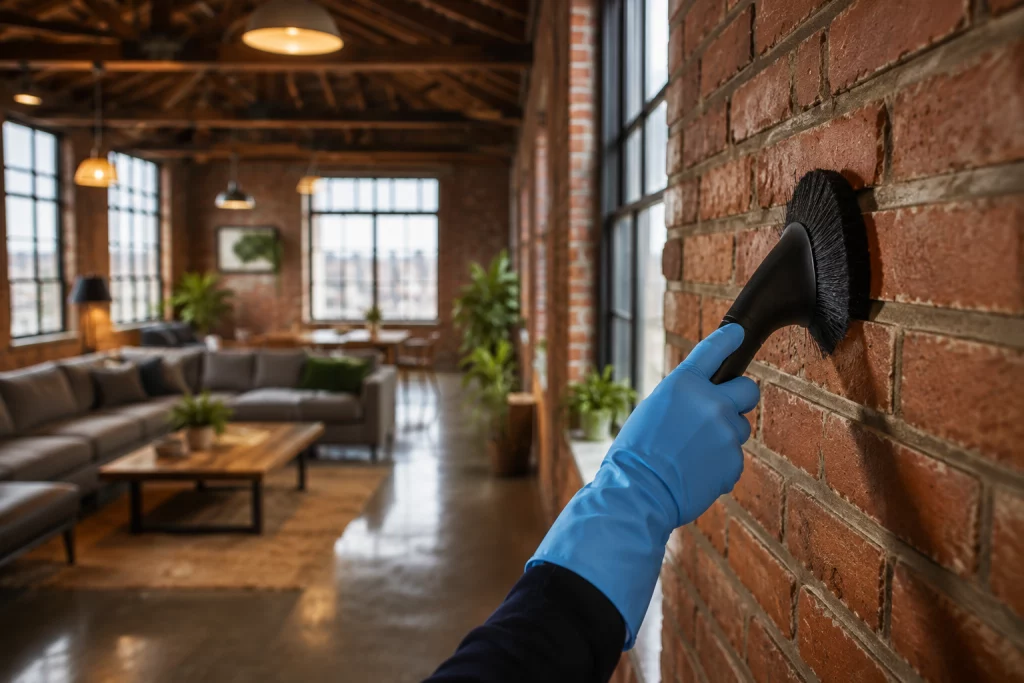
Exposed Brick Loft Cleaning: What Changes From a Standard Apartment
Exposed brick loft cleaning isn’t the same job as cleaning a drywall apartment, even when the square footage matches. Wicker Park has one of the highest concentrations of converted industrial lofts in Chicago — old printing houses, truck depots, and factory buildings turned into residential units since the 1990s — and that history is exactly what makes the cleaning checklist different.
At Express Clean, we run our Wicker Park cleaning services across both loft conversions and standard apartments every week, and the difference shows up the moment you walk in: the surfaces are different, the dust behaves differently, and a few “obvious” cleaning habits actually do damage in a loft that they wouldn’t in a drywall unit.
Why Exposed Brick Loft Cleaning Is a Different Job
Most Wicker Park lofts fall into one of two categories, and each one changes what a cleaning visit actually needs to cover:
Authentic conversions are buildings originally constructed in the early 1900s — former factories, warehouses, or commercial buildings — converted to residential lofts starting in the 1990s. These units typically have century-old brick, exposed timber beams, and original hardwood or even old freight elevator hardware left as a design feature. Modern industrial lofts are newer construction built to mimic that aesthetic, using poured concrete and exposed ductwork instead of real brick and timber. Both look similar in photos. They don’t clean the same way.
Exposed Brick Loft Cleaning: What Actually Changes
- Brick is porous and sheds dust constantly. Unlike painted drywall, exposed brick has a textured, porous surface that holds dust in its pores and releases it slowly — which means brick walls need regular dry dusting with a soft brush attachment, not a wet wipe-down that can drive grime deeper into the mortar.
- Mortar joints stain differently than grout. Old mortar between brick courses absorbs moisture and oil-based residue (especially in kitchen-adjacent brick walls) in a way that’s much harder to reverse than resealing tile grout — so spot-cleaning early matters more here than in a standard kitchen.
- Concrete floors need pH-neutral care, not the products made for hardwood. Polished concrete, common in modern industrial lofts, can etch or dull under acidic cleaners that would be perfectly safe on sealed hardwood.
- Exposed ductwork and timber beams collect dust at ceiling height. A standard apartment hides this behind a flat ceiling; a loft puts it on display, which means dust that would normally go unnoticed becomes visibly obvious within days.
- Open floor plans mean more uninterrupted square footage per room. Fewer walls to clean, but larger continuous floor and surface areas — which usually shifts more of the visit’s time toward floors and less toward corners and trim.
The Express Clean Checklist™ for Loft Conversions
Every visit still runs on the same four-step Express Clean Checklist™ — walkthrough and priority mapping, top-to-bottom cleaning, a detail pass on high-touch surfaces, and a final quality check — adjusted for what a loft actually needs: dry-dusting brick instead of wiping it, pH-neutral care on polished concrete, and extra attention at ceiling height where exposed ductwork and beams collect what a dropped ceiling would normally hide. According to EPA guidance on indoor air quality, surface area and ventilation type both affect how fast dust resettles indoors — which lines up with what we see firsthand in open-plan lofts versus compartmentalized apartments.
What Not to Do in an Exposed Brick Loft
A few habits that are completely safe in a standard apartment can cause real damage in a loft:
- Don’t pressure-wash or heavily wet-mop exposed brick. Saturating old mortar accelerates crumbling over time.
- Don’t use vinegar-based or acidic cleaners on polished concrete. They can etch the sealed finish permanently — the same products that are fine on tile can ruin a concrete floor.
- Don’t skip the ceiling-height dusting. Exposed beams and ductwork in a loft are far more visible than a flat ceiling, so skipped dust shows up faster than in a standard apartment.
This is the same level of care behind our apartment cleaning and maid service visits throughout Wicker Park’s loft buildings near Damen and Milwaukee Avenue.
Exposed Brick Loft Cleaning and Your Security Deposit
If you’re renting, exposed brick loft cleaning matters more at move-out than most tenants realize. Under Chicago’s Residential Landlord and Tenant Ordinance (RLTO), landlords have 45 days after you vacate to return your security deposit, and if they withhold any of it, they’re required to send an itemized statement of damages within 30 days, with receipts or cost estimates attached, according to Illinois Legal Aid’s guide on security deposits. The ordinance only allows deductions for damage beyond “normal wear and tear” — and that distinction gets murky fast in a loft, since a landlord could try to bill you for mortar discoloration or scuffed concrete that was already there before you moved in.
The simplest protection is the one most renters skip: photograph the brick, mortar joints, and concrete floor at move-in, and again before move-out. If a wall already had old staining or a hairline crack in the mortar, a dated photo from day one is the difference between a $0 deduction and a charge you can’t dispute.
What Counts as Real Damage vs. Normal Wear in a Loft
Illinois law doesn’t define “normal wear and tear” precisely, but in practice, a few things tend to fall clearly on each side in a loft:
- Normal wear (not chargeable): minor dust discoloration on brick from years of HVAC circulation, light scuffing on sealed concrete from regular foot traffic, and natural fading of exposed timber from sun exposure.
- Real damage (potentially chargeable): chipped or gouged brick from moving furniture without padding, acid-etched concrete from using the wrong cleaning product, and mortar that’s crumbling because it was repeatedly wet-mopped or pressure-washed.
This is exactly why the “what not to do” list above isn’t just about keeping the space looking good day-to-day — using the wrong product or method on brick and concrete is one of the few things that can turn ordinary wear into a deduction-worthy problem.
DIY Loft Cleaning vs. Hiring a Professional: What It Actually Costs
For a typical one-bedroom loft, DIY cleaning supplies (a soft-bristle brush attachment, pH-neutral concrete cleaner, microfiber cloths) run roughly $25-$40, plus 2-4 hours of your own time — more if you’re cleaning at ceiling height around exposed ductwork for the first time. A professional cleaning for the same loft typically falls in a comparable price range once you factor in the specialized products and the time it takes to do it correctly, but it’s finished in under two hours and doesn’t carry the risk of using the wrong product on brick or concrete by mistake.
The real cost comparison isn’t just dollars — it’s risk. A bottle of the wrong cleaner used once on polished concrete can permanently dull the finish, turning a $30 DIY cleaning session into a repair or refinishing cost that runs into the hundreds.
FAQ
Is exposed brick loft cleaning more expensive than a standard apartment?
Not necessarily based on brick alone — pricing is based mostly on square footage and condition. Some lofts do take slightly longer due to higher ceilings and more surface area, which we factor into scheduling rather than a flat surcharge.
Can I clean exposed brick myself between professional visits?
Yes — a soft-bristle brush attachment on a vacuum or a dry microfiber duster is the safest option for upkeep between visits. Avoid wet cleaning brick yourself unless you’re using a product specifically rated for masonry.
Do modern industrial lofts need different products than authentic conversions?
Often, yes. Authentic lofts with real brick and timber need gentler, dry-cleaning methods, while modern industrial lofts with poured concrete and drywall accents can handle more standard products, as long as the concrete itself stays away from acidic cleaners.
Why does dust seem to build up faster in my loft than my old apartment?
Open floor plans and exposed ductwork at ceiling height both contribute — there’s more surface area for dust to settle on, and ductwork that would be hidden behind a dropped ceiling in a standard apartment is fully exposed in most lofts.
Can my landlord charge me for brick discoloration when I move out?
Generally no, if it’s from normal wear like years of dust or sun exposure — Chicago’s RLTO only allows deductions for damage beyond normal wear and tear, and landlords must provide an itemized statement with receipts within 30 days of move-out.
How do I prove brick or concrete damage was already there when I moved in?
Dated, timestamped photos taken at move-in are the strongest evidence. Without them, it becomes your word against the landlord’s when a deposit dispute comes up.
Related Reading
Living in a converted loft near Milwaukee or Damen? Express Clean’s Wicker Park team adjusts the checklist to brick, concrete, and open layouts — not a one-size-fits-all routine. Get a free quote for your loft, or call (312) 600-2850.