
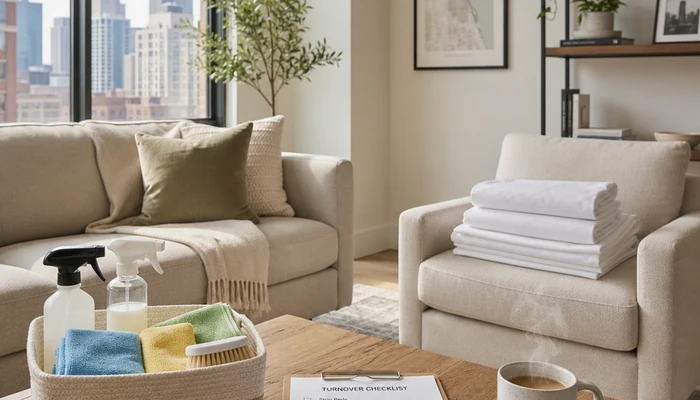
Same-Day Airbnb Turnovers in Chicago: What Hosts Must Have Ready Before Cleaners Arrive
When one Airbnb guest checks out and another is due the same day, the hours between reservations can feel like a race. Same-Day Airbnb Turnovers in Chicago: What Hosts Must Have Ready Before Cleaners Arrive is a practical question about more than the cleaning itself: the cleaner needs timely access, clear instructions, usable supplies, and an accurate picture of the property before work begins.
This guide gives hosts a preparation framework they can use before every tight changeover. You will learn what to confirm with the departing guest, what information to send the cleaning team, how to prepare linens and restocking items, which property issues to flag, and how to make a final readiness decision without rushing past important details. It also explains what can reasonably fit into a short window, what may need a separate repair or deeper service, and how a reliable handoff can prevent avoidable delays. A checklist near the end brings those steps together for a repeatable process.
Start the turnover clock with confirmed checkout and check-in times
A same-day schedule only works when the time available is real, not assumed. Start by checking the reservation calendar and the agreed checkout and check-in times. Then ask whether the outgoing guest has confirmed their departure. A late checkout, delayed flight, or unresolved access issue can reduce the cleaner’s working window before anyone has entered the unit.
Build the window around actual access
Calculate the time between the moment the cleaner can enter and the time the next guest is expected to arrive. Include time for entry, a walkthrough, cleaning, laundry handling, restocking, and a final check. If the new guest has early arrival approval, treat that as a firm deadline. Do not schedule a cleaner based only on the standard checkout and check-in times if your listing has exceptions.
Confirm departure without disrupting the guest
Send a courteous reminder before checkout that repeats the departure time and the few actions the guest is expected to take, such as placing used towels in a specified hamper. Avoid instructions that require guests to perform cleaning tasks. Your goal is a clear departure, not to shift the turnover work onto them.
- Verify checkout and check-in times against the calendar.
- Confirm any early arrival, late departure, or luggage-drop arrangement.
- Identify who will notify the cleaner if the unit is not vacant.
- Decide in advance what to do if access is delayed.
If there is less time than your usual process needs, tell the cleaning team before they travel. An honest time estimate helps everyone prioritize the work safely and lets you adjust the guest plan if needed.
Give cleaners one reliable way into the property
Access problems can consume a meaningful part of a short turnover. Share one primary entry method and a backup, along with any building procedures that matter. For a Chicago apartment, that may include a callbox, concierge desk, elevator restriction, parking instructions, or a key stored in a designated lockbox. Provide only the access information needed for the scheduled visit, and update it if a code or key location changes.
Test codes and keys before checkout day
A code that worked last week may have expired, and a key may have been returned to the wrong place. Test the current access method ahead of the turnover when possible. If the property uses a smart lock, confirm its battery status and make sure the cleaner knows which door to use. Keep a backup plan that does not depend on the departing guest answering a message.
Explain building rules that affect arrival
Write down practical arrival details: where a cleaner may park, whether the front desk needs advance notice, which elevator serves the unit, and whether cleaning carts or supplies are restricted. Do not assume that a first-time cleaner knows the building. Short, direct directions are easier to use than a long description mixed with unrelated hosting notes.
- Primary entry method and a tested backup.
- Unit number and correct entrance.
- Building contact or check-in procedure, if relevant.
- Parking, loading, elevator, and quiet-hour details.
- A reachable host or manager for access failures.
For hosts managing remotely, a documented handoff is particularly useful. These access practices also support broader remote Airbnb management planning, but the turnover-day instructions should remain brief enough to scan at the door.
Separate clean linens from used laundry before the team arrives
Fresh bedding and towels are among the first things guests notice, and laundry can become the bottleneck in a compressed schedule. Decide whether the cleaner will wash items in the unit, use a commercial laundry arrangement, or replace used sets with clean backup stock. Do not assume one washer-and-dryer cycle will finish before check-in; cycle time, machine capacity, and drying time vary.
Prepare complete sets, not loose pieces
Keep a full replacement set for every bed and a sufficient towel set for the expected occupancy. Store each set together and label it by bed size or room. This reduces the chance of discovering that a pillowcase or fitted sheet is missing after the old bedding has been removed. If your property has a sleeper sofa or a crib, include its linens in the same inventory.
Choose a laundry plan that fits the available hours
When clean backups are available, the team can make beds while used items are contained for later laundering. If the turnover depends on on-site laundry, communicate the machine instructions and the location of detergent. Confirm whether the cleaner should start a load, transfer it, or leave it for a host or laundry partner. Make sure the plan accounts for items that cannot be machine-dried or washed with ordinary detergent.
- One complete clean set per sleeping area, plus a backup where feasible.
- Enough bath towels, hand towels, and washcloths for the reservation.
- A designated, ventilated place for used textiles.
- Clear instructions for stained, damp, or damaged linens.
Do not ask a cleaner to hide a stain by folding the affected area out of sight. A damaged or permanently stained item may need replacement, and the host should decide how to handle it. For guidance on maintaining a sleep surface between stays, see this separate resource on mattress care between Airbnb guests.
Stage guest supplies where they can be counted quickly
Restocking is easier when supplies have a home and the team can tell at a glance what is missing. Set aside the items that should be replenished for each reservation and tell the cleaner where to find them. The goal is not to create elaborate hotel-style amenities; it is to make sure the basics promised in your listing are present, clean, and in usable condition.
Make a property-specific restock list
List only the items you provide, along with the expected quantity and storage location. Depending on the property, this may include toilet paper, hand soap, dish soap, trash bags, paper towels, coffee supplies, or dishwasher tablets. Keep guest supplies separate from cleaning chemicals. Label backup stock so a cleaner does not have to open every cabinet to find it.
Check bathroom and kitchen essentials separately
Bathrooms and kitchens often need different items, storage, and inspection. A bathroom restock list can cover soap, toilet paper, a clean bathmat, and the towel count. A kitchen list can cover dishwashing supplies, a fresh sponge if supplied, and any basic items your listing promises. Review the property-specific details in these resources on Airbnb bathroom essentials and Airbnb kitchen supplies.
- Put replenishment stock in one known location.
- List the normal quantity for each guest-facing item.
- Flag items that need host approval before replacement.
- Keep chemicals and equipment away from guest amenities.
Ask the cleaning team to report low stock rather than guess at substitutions. A simple shortage note helps the host restock for the next reservation without delaying the room reset.
Share the property’s priorities and off-limits areas
A cleaner can work more efficiently when the host identifies the details that are unique to the unit. Provide a short property brief that names delicate surfaces, appliances with special instructions, areas guests must not enter, and anything that needs extra attention after the previous stay. Focus the brief on information that changes how the cleaner should work.
Flag fragile finishes and equipment
Identify surfaces that need a specific care method, such as natural stone, unfinished wood, specialty glass, or a manufacturer-sensitive appliance. If you have product instructions, leave them in an accessible place. Do not ask a cleaner to experiment with an unfamiliar chemical on a valuable finish. When product compatibility is uncertain, a cautious approach and a host follow-up are safer than an improvised treatment.
Mark owner storage and private spaces
Make locked closets and private storage areas unmistakable. If the cleaning team must enter a supply closet, say so and explain what may be used. If a room or cabinet is off limits, state that clearly. This reduces accidental handling of personal belongings and prevents a cleaner from losing time trying to determine whether an area is part of the guest space.
- Point out valuable, fragile, or easily damaged items.
- List surfaces that require a specific product or tool.
- Identify owner-only areas and authorized supply storage.
- Note any appliance or fixture that is already out of order.
Keep sensitive items secured before the guest leaves when possible. A checklist cannot replace secure storage, and cleaners should not be asked to make decisions about personal property, valuables, or items left behind.
Tell the team what changed during the last stay
A standard reset assumes the property is in its usual condition. A same-day handoff should also include a short report of anything unusual: a spill, a broken item, a pet stay, extra trash, a maintenance concern, or a guest report about an odor. The earlier the team knows, the more accurately it can plan the work and alert you if the condition is outside the expected scope.
Distinguish routine soil from a problem that needs a host decision
Ordinary crumbs, fingerprints, and bathroom residue are part of the usual reset. A large spill, suspected bodily-fluid contamination, broken glass, heavy smoke odor, pest evidence, or a damaged fixture may call for protective measures, a specialized response, or a maintenance professional. Ask the cleaner to pause and contact you if the situation falls outside agreed instructions. Do not pressure anyone to handle an unknown hazard just to meet a check-in time.
Set a simple reporting format
Use a consistent method for reporting issues, such as a message with the room, a brief description, and a photo when appropriate. Tell the cleaner which issues need immediate contact and which can go into the final turnover report. If a guest leaves belongings behind, have a host process for secure storage and guest contact rather than leaving the cleaner to decide what to discard.
- Describe any guest-reported spill, damage, or maintenance problem.
- State whether pets, smoking, or an unusual event were reported.
- Give a clear pause-and-contact instruction for unexpected hazards.
- Keep the cleaning team’s reporting channel available during the visit.
For properties with a no-smoking policy, a suspected violation can affect odor treatment and the schedule. A separate explanation of smoking prevention for Airbnb hosts can help hosts plan policy communication, while the turnover brief should focus on what was actually observed.
Agree on the order of work for a compressed changeover
When time is limited, a defined sequence helps the team avoid backtracking. The exact workflow depends on the property, the crew, and the work agreed in advance. Generally, the first steps are to enter safely, ventilate when appropriate, identify any issue that needs host direction, and gather used textiles and waste. The cleaner can then move through the rooms using a consistent path, with kitchens and bathrooms receiving their planned attention before a final reset.
Keep room priorities specific
“Do the important areas first” is too vague to guide a cleaner. Instead, name the rooms and tasks that matter most for the next guest. For example, identify the required bedroom setup, bathroom reset, kitchen surfaces, and high-touch points. Clarify whether the visit includes inside appliances, interior windows, laundry, or other tasks beyond the regular changeover. Do not assume that every extra task fits into the same short appointment.
Use a room-by-room finish rather than scattered touch-ups
Completing one area before moving to the next can make it easier to notice what remains. The host’s list should define the expected finish without prescribing unsafe shortcuts. A reliable team can apply its own method while following the agreed scope, surface instructions, and quality checks. If the unit is larger or has several bathrooms, plan realistic staffing and timing rather than compressing every task into an unrealistic window.
- Entry and initial condition check.
- Waste and used-textile collection.
- Planned cleaning by room and surface.
- Bed setup and agreed supply restocking.
- Final walkthrough and issue report.
When booking a provider, share the unit size, layout, expected condition, guest count, and time available. That information helps the company confirm whether the requested work can be completed during the turnover window. Hosts can review factors that affect Airbnb cleaning costs separately; this article focuses on readiness rather than pricing.
Match the task list to the time you actually have
Not every turnover has the same scope. A lightly used studio with clean backup linens is different from a multi-bedroom property with multiple bathrooms, heavy cooking, or laundry that must finish on site. A sensible plan separates the routine reset from add-on work. That distinction gives the cleaner a clear target and helps the host make a realistic check-in decision.
Set a minimum guest-ready scope
Before the season starts, define the essential work that must be complete before a guest enters. It commonly includes a clean and orderly sleeping area, bathroom, kitchen, and shared space; fresh linens; removal of guest waste; and a check that the advertised basics are available. Tailor the list to your property and promises. If an essential item cannot be completed, the host must decide whether to delay arrival, offer an alternative, or communicate a change.
Move nonessential extras out of the critical path
Some tasks are valuable but should not be allowed to obscure the core reset. Examples may include organizing owner storage, washing decorative throws that were not used, or addressing a maintenance issue. Agree in advance which extras fit when time allows and which require separate scheduling. Deep cleaning and repairs should not be silently folded into every same-day appointment.
- Label tasks as required, conditional, or separate work.
- Decide which items need host approval before time is spent.
- Set a point when the team should report a delay.
- Keep guest arrival flexible only if your listing and communication allow it.
Cleaning outcomes depend on the property’s condition, guest activity, pets, surface materials, and time available. Some stains, odors, or damage may not be fully reversible during a routine turnover. A clear scope protects the guest experience without encouraging rushed or unsafe work.
Prepare a safe plan for products, ventilation, and unusual conditions
Have relevant product information ready if you supply chemicals or require a specific approach to a surface. Cleaning and disinfecting are not interchangeable terms: routine cleaning removes soil, while disinfectants have label-specific directions for use. Whether a disinfectant is appropriate depends on the surface, the intended use, the product label, and the situation. Avoid asking a cleaner to mix products or use a chemical outside its labeled directions.
Use product labels as the source for directions
If you expect a particular disinfectant to be used, make sure the product is registered for its intended use and that the label directions can be followed, including any required contact time and surface compatibility. The EPA’s List N product information is specific to products identified for use against SARS-CoV-2; it is not a general instruction to disinfect every surface during every turnover. Always follow the individual product label and applicable safety guidance.
Do not schedule work through an unresolved hazard
If the team reports broken glass, a suspected chemical spill, pest activity, or another condition that may require special precautions, pause and get the right direction. Keep children, guests, and other people out of the affected area. A short-term rental deadline does not make an unknown hazard safe to handle. Infection prevention education from the Association for Professionals in Infection Control and Epidemiology provides broader learning resources; a host should still rely on the product label and qualified guidance for a specific exposure.
- Keep products labeled and stored away from guest supplies.
- Never ask staff to combine cleaning chemicals.
- Give surface-care instructions for sensitive finishes.
- Escalate suspected hazards rather than improvising.
Ventilation can also depend on weather, building conditions, and product directions. Provide practical instructions, but do not ask a cleaner to leave a unit unsecured or to ignore building safety requirements. If a strong odor or contamination concern remains, contact the cleaner and make a guest-readiness decision based on the actual condition.
Use a final handoff that shows what is ready and what is not
The cleaner’s departure should not be the end of the host’s decision process. Agree on a brief handoff that confirms the work is complete, identifies any low stock, and reports maintenance or condition issues. If photos are used, define which areas matter and how those images should be shared and stored. A photo can help confirm setup, but it does not replace a proper inspection or prove that every surface is free of risk.
Check guest-facing details before releasing the unit
When time allows, the host or manager should verify the advertised sleeping setup, bathroom presentation, kitchen basics, and access information. Confirm that cleaners’ equipment and supplies have been removed from guest areas and that owner-only spaces remain secure. Check that the unit is not left with wet surfaces, open windows, or a door that has not latched. These final details can prevent a clean room from becoming an awkward arrival.
Record exceptions instead of hiding them
If something could not be completed, document it and decide what happens next. A missing item, appliance issue, permanent stain, or repair need may require replacement, disclosure, or a change to the guest arrangement. A calm, timely message is better than hoping the guest will not notice. The host remains responsible for deciding whether the property is ready to occupy.
- Confirm the agreed rooms and tasks are finished.
- Review the cleaner’s notes and any requested photos.
- Restock or resolve reported shortages.
- Address safety, maintenance, and guest-impacting exceptions.
For a broader view of the guest experience beyond cleaning, review these ways to improve the Airbnb guest experience. The final turnover handoff should remain focused on the actual condition and readiness of the unit.
Choose a staffing and backup plan before a busy date
Hosts often need same-day cleaning most during holidays, major events, and high-occupancy periods, when cleaner availability may be limited. Do not wait until the departure morning to find out whether the assigned team can attend. Confirm the appointment, expected arrival window, contact method, and scope in advance. If you manage more than one unit, make sure the schedule accounts for travel time between properties.
Decide who handles a delay or no-access situation
Name one person who can make decisions if a guest has not left, the key fails, or a cleaner finds unexpected damage. Share that person’s number and the limits of their authority. For example, can they approve a supply purchase or a modest schedule change? Which decisions must go to the owner? Clear authority prevents a cleaner from waiting for several people to respond.
Have a realistic fallback, not an assumed rescue
A backup cleaner, alternate laundry plan, or later guest arrival may help, but none should be treated as guaranteed until confirmed. If a same-day slot is unavailable, adjust the guest plan rather than implying that a team can arrive instantly. When you need to explore timing, you can check same-day cleaning availability or review an Airbnb cleaning service option. These are service choices; they do not replace providing accurate access and property information.
- Confirm the appointment and arrival range before checkout day.
- Allow for travel and building access between properties.
- Name the decision-maker for unexpected issues.
- Agree on what happens if the original schedule cannot be met.
Some hosts benefit from keeping a written turnover log with arrival time, condition notes, supply use, and recurring maintenance concerns. Over time, the log can show whether your usual buffer is adequate and which parts of the preparation process most often cause delays.
Run this host-ready checklist before the cleaner arrives
Use this checklist the day before or early on checkout day. A checklist helps prevent omissions, but it cannot guarantee that a property will be ready on time. The host should update it for the unit’s layout, guest promises, building rules, and the scope agreed with the cleaning team.
Calendar, access, and communication
- Confirm the outgoing checkout and incoming check-in times.
- Verify the unit is expected to be vacant when the team arrives.
- Test the lock code or confirm the key and backup method.
- Share building entry, parking, elevator, and front-desk instructions.
- Keep the host or manager contact reachable during the appointment.
Rooms, linens, and supplies
- Prepare complete clean bedding and towel sets.
- Label the location of backup linens and guest supplies.
- Tell the cleaner where used laundry should go and how it will be handled.
- List the expected bathroom and kitchen restock quantities.
- Secure valuables, owner belongings, and private documents.
Condition, scope, and final check
- Report spills, pet stays, smoke concerns, damage, or maintenance issues.
- Flag delicate materials, off-limits areas, and product restrictions.
- Separate essential reset tasks from optional extras.
- Agree on a pause-and-contact process for unexpected hazards.
- Plan who will review the handoff and make the final readiness decision.
If several checklist items remain uncertain, resolve them before the team is en route. A well-prepared host gives the cleaner a clear starting point and gives the incoming guest a more dependable arrival experience.
Frequently asked questions about same-day Airbnb turnovers
What should an Airbnb host send before a same-day turnover?
Send the confirmed schedule, access instructions, building details, agreed task list, linen and supply locations, surface-care notes, and a direct contact for decisions. Include any known issue from the departing guest’s stay. Keep the message organized so a cleaner can find critical details quickly.
How much time should I leave between guests?
There is no single interval that fits every listing. The right buffer depends on property size, number of bathrooms, laundry arrangements, guest condition, travel and access time, and the scope of work. Ask the cleaning provider what information it needs to estimate a realistic appointment. Then use your own turnover history to adjust the schedule.
Should guests wash dishes or strip the beds?
Hosts may make reasonable checkout requests, but these should not replace the cleaning plan or create confusion about who is responsible for preparing the unit. Give guests concise instructions that match your listing and local requirements. Tell the cleaning team what to expect even if guests are asked to place towels in a hamper or load a dishwasher.
Can cleaners complete laundry during the turnover?
Sometimes, but it depends on the number of loads, machine capacity, cycle and drying times, and the visit’s other tasks. A complete backup set reduces the risk that a delayed laundry cycle holds up the room setup. Confirm in advance whether the cleaner is responsible for starting or transferring laundry, and do not assume it will be dry by check-in.
What if the property is much dirtier than expected?
Ask the cleaning team to report the condition and any work that falls outside the agreed scope. The host can then approve additional time, arrange specialized help, modify arrival plans, or make another appropriate decision. Heavy soil, damage, unusual odors, and suspected hazards may not be resolved within a routine turnover visit.
Does same-day mean a cleaner can arrive immediately?
No. Same-day availability depends on the provider’s schedule, location, travel time, property details, and the requested scope. Contact the company as early as possible and share accurate information. Do not promise an arrival time to a guest until it is confirmed.
Do I need disinfectant used on every surface?
Not necessarily. Cleaning removes soil, while disinfectants have specific label directions and intended uses. Choose products appropriate for the surface and situation, and follow the label. Never mix products or use a disinfectant contrary to its directions. A cleaner can clarify the agreed product approach, but the host should avoid unsupported claims about what a treatment guarantees.
What should I do if the cleaner reports damage or an item left behind?
Ask for a concise description and, where appropriate, a photo. Decide whether the item needs secure storage, guest contact, repair, replacement, or another follow-up. Cleaners should not be expected to discard personal belongings or make decisions about a guest’s property without clear direction.
Make the handoff repeatable, then adjust it to your property
A successful same-day turnover begins before checkout. Confirm the true work window, make access dependable, prepare clean linens and guest supplies, share property-specific instructions, and tell the cleaner about anything unusual. Then agree on priorities, escalation steps, and a final handoff that records both completed work and unresolved issues.
Use the checklist as a starting point rather than a promise that every turnover will be identical. Track where delays happen and revise your instructions when building access changes, equipment fails, or guest patterns shift. When the property needs more time than the reservation gap allows, make a practical plan instead of relying on rushed work. A clear process supports a cleaner’s work and helps a host make a responsible decision about when the unit is ready.
About Express Clean
Express Clean provides cleaning support for residential and commercial properties, including recurring house cleaning, deep cleaning, move out cleaning, office cleaning, and facility cleaning. The team follows checklists and quality standards, uses professional products and equipment suited to different surfaces, and emphasizes clear communication and attention to high-touch areas, kitchens, bathrooms, and shared spaces. Express Clean helps households and businesses in Chicago, Illinois and nearby areas keep their spaces clean and healthy. Scheduling options and the work available depend on the property, timing, and requested scope.
cleaning companies in chicago, airbnb cleaning services in Chicago il, Chicago airbnb cleaning service, Cicero airbnb cleaner, Downers Grove airbnb cleaning services, airbnb cleaning Palos Heights IL, airbnb cleaning services in Lake Bluff, Glenview airbnb cleaning service, airbnb cleaning service in Addison, Winfield airbnb cleaning