
Restaurant Cleaning Before a Health Inspection: What Pros Prioritize First
A health inspection can feel unpredictable, especially when a restaurant is busy and many cleaning tasks compete for attention. Restaurant Cleaning Before a Health Inspection: What Pros Prioritize First is a practical way to organize the work: address immediate hazards, protect food and food-contact surfaces, inspect high-risk areas, and verify that the team can maintain the result during service.
This guide explains how professional cleaners and restaurant teams can prepare without treating a last-minute polish as a substitute for daily sanitation. You will find a prioritized walkthrough, a room-by-room checklist, guidance on communicating with staff, and a simple decision framework for choosing what to correct first. You will also learn where cleaning ends and other responsibilities begin: cleaning does not replace required temperature controls, food handling practices, pest management, equipment maintenance, or compliance with applicable rules.
Every facility and inspection process is different. Use this guide alongside current local requirements and your own food-safety procedures. The goal is a clean, orderly space that is ready for normal operation—not a temporary appearance that hides unresolved problems.
Begin with hazards that could affect food or people
Professionals do not usually begin by polishing the most visible surface. They first look for conditions that could cause immediate harm, contaminate food, or make the workplace unsafe. Correcting these issues early also prevents later cleaning from spreading soil or creating a new hazard.
Stop active contamination before routine cleaning
If a spill, leak, sewage backup, pest evidence, broken glass, or suspected contamination is present, pause nearby food work and follow the restaurant’s response procedure. Keep people away from the affected area, protect exposed food, and involve the manager responsible for food safety. Cleaning staff should not guess about whether food is safe to serve or whether a contaminated area can reopen.
For illness-related contamination, follow established workplace procedures and current public-health guidance. The CDC’s norovirus prevention guidance explains prevention steps such as handwashing and careful handling of contaminated surfaces. A cleaner should use the product, contact time, protective equipment, and disposal method specified by the facility’s procedure and the product label.
Remove slip, trip, and access hazards
Before wet cleaning, identify grease, standing water, loose mats, obstructed exits, and cords crossing walkways. Clear the route, post warnings where needed, and keep the area out of use until the floor is safe. Cleaning should reduce risk, not create a new slip hazard while employees or inspectors move through the space.
- Isolate active spills and protect nearby food and equipment.
- Remove broken glass or sharp debris using the approved method.
- Address leaks and standing water; report the source rather than only wiping the surface.
- Keep exits, handwashing stations, and required work areas accessible.
- Escalate pest activity, damaged equipment, or structural concerns to the manager.
Set the work order around contamination risk
A dependable inspection-prep sequence moves from cleaner areas toward dirtier ones and from high surfaces toward low surfaces. It also keeps tools for restrooms, floors, and food-contact areas separate. The sequence matters: cleaning a floor first and then wiping overhead dust onto it creates rework, while using one cloth across unrelated areas can spread contamination.
Use a clean-to-dirty, high-to-low route
Start with clean storage and food-preparation areas, then work toward dishwashing, waste, and floor zones. Within each space, address higher surfaces before lower ones. Finish floors after other cleaning is complete. Change cloths and tools as they become soiled, and follow the site’s color-coding or separation system.
Keep the inspection route and cleaning route distinct
An inspection may move through a facility in a different order from the cleaning crew’s route. Managers should check that all relevant areas are ready, but a walk-through should not interrupt food preparation or send staff through freshly cleaned, wet spaces. Agree on access times, room ownership, and a clear handoff before work starts.
| Priority | What to address | Why it comes early | Useful verification |
|---|---|---|---|
| 1. Immediate risk | Spills, contamination, blocked access, broken glass, active leaks | Protects people and prevents spread | Manager confirms isolation, response, and safe reopening |
| 2. Food protection | Food-contact surfaces, utensils, storage areas, handwashing access | Reduces contamination opportunities | Visual check plus required site sanitation procedure |
| 3. High-touch points | Handles, switches, faucets, shared controls | Frequently touched during normal work | Clean, intact, and included in the routine |
| 4. Supporting spaces | Restrooms, waste areas, floors, dining area | Supports safe, orderly operation | Area-specific checklist and final walk-through |
| 5. Records and follow-up | Cleaning logs, maintenance notes, corrective actions | Shows how the routine is managed | Entries are current, accurate, and assigned |
This table is a prioritization aid, not a substitute for a required inspection checklist or food-safety plan. The manager should adjust it to the layout, menu, equipment, and current condition of the restaurant.
Check food-contact surfaces as a separate task
Food-contact surfaces deserve their own pass because “looks clean” and “ready for food use” are not the same standard. The appropriate sequence depends on the surface, product label, and the restaurant’s procedures. Staff should know when a surface needs cleaning, when it must be sanitized, and when it can return to use.
Work from preparation equipment outward
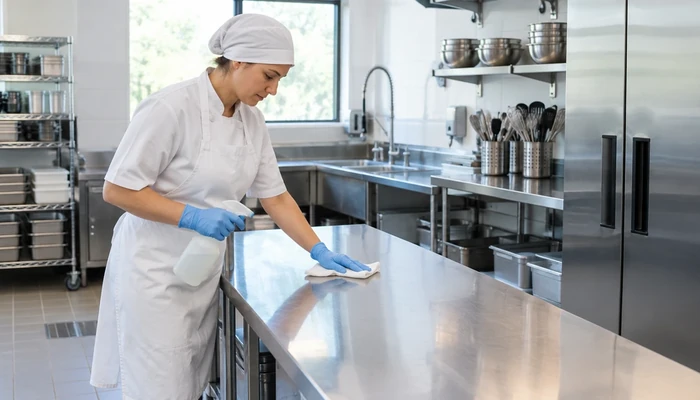
Inspect cutting boards, counters, slicers, utensils, food-contact parts of equipment, and other surfaces used during preparation. Remove food debris, clean with the approved method, and apply sanitizer when required by the facility’s procedure. Observe the product’s label instructions, including dilution and contact time. Do not mix chemicals or use an unapproved product because it seems stronger.
Prevent chemical and tool mix-ups
Store chemicals in their designated area, keep containers identified, and use measuring or dispensing systems as directed. Use separate, clean tools for food-contact surfaces. A rag used on a floor, drain, or waste bin should never move to a preparation counter. If a cloth or solution is visibly soiled, replace it rather than continuing to spread residue.
- Check that equipment is safe to clean and follow manufacturer instructions.
- Remove detachable parts only when staff are trained to do so.
- Inspect seams, handles, guards, and undersides where residue can collect.
- Keep cleaned items protected from splash and recontamination.
- Return equipment to service only when the required process is complete.
For stainless-steel surfaces, use a method compatible with the finish and the product label. The stainless-steel cleaning guide offers surface-care context, while the restaurant’s own food-contact procedure should govern sanitation and return to use.
Inspect cold storage without turning cleaning into food handling
Refrigerators, freezers, and other storage areas can reveal residue, spills, damaged seals, clutter, or maintenance concerns. A cleaning walkthrough can identify visible issues, but it should not become an informal food-safety decision. Restaurant staff responsible for food handling must follow applicable procedures for storage, labeling, and temperature monitoring.
Look for residue, leaks, and obstructed airflow
Check shelves, handles, door edges, gaskets, and floors for spills or buildup. Note damaged seals, unusual moisture, or blocked vents for the manager. Clean only as permitted by the equipment instructions and the restaurant’s process. Avoid moving food unnecessarily or leaving a unit open while cleaning.
Separate corrective cleaning from maintenance
A sticky handle can be cleaned; a torn gasket or a unit that is not holding conditions may need repair and prompt management action. Record the issue, identify who will follow up, and do not assume a surface-level wipe resolves an equipment problem. Clear communication is particularly important when the next shift depends on the same storage space.
During the check, confirm that the area remains orderly and that food is protected from cleaning products and splash. Cleaning staff can report visible concerns, but they should not change labels, discard food, or make temperature-related decisions unless those tasks are assigned to them and covered by the site’s procedures.
Give handwashing and high-touch points a deliberate pass
People move constantly between preparation, service, storage, and shared equipment. That makes frequently touched points easy to overlook during a rushed clean. A deliberate pass should include the areas staff touch repeatedly and the handwashing stations they rely on.
Check the whole handwashing station
Look for visible soil around the sink, faucet, handles, nearby wall, and splash zone. Make sure the station is not blocked by boxes, tools, or cleaning equipment. The manager should verify that required supplies are present under the restaurant’s procedures. A clean sink that is inaccessible or not ready for use does not support the intended workflow.
Map high-touch points by work pattern
Build the list around how people actually move through the restaurant. Common examples include door handles, refrigerator pulls, switches, shared controls, faucet handles, payment equipment, and service-area touchpoints. The right set varies by layout and job duties, so a short site-specific map is more useful than a generic list.
- Identify who owns each point during the pre-opening check.
- Use compatible products and observe label directions.
- Change tools between distinct zones and when visibly soiled.
- Record any damaged dispenser, loose fitting, or access problem.
- Include touchpoints in routine shift work, not only inspection preparation.
Cleaning and sanitizing are different tasks. Use the restaurant’s instructions to determine which treatment applies to each surface, and never assume a quick wipe is enough.
Review dishwashing, drains, and waste boundaries
Dishwashing and waste areas combine moisture, food residue, equipment, and frequent movement. They should be checked after food-contact work has been protected from contamination, with dedicated tools and clear separation from clean storage or preparation zones.
Look beyond the front of the dish station
Inspect accessible sides and handles, splash areas, racks, and surrounding surfaces for visible residue. Check that clean and used items remain separated according to the facility’s process. Report equipment that appears damaged or is not working as intended; a cleaner should not improvise repairs or alter settings.
Keep waste movement from crossing clean work
Check bin exteriors, lids, nearby floor edges, and the route used to remove waste. Replace liners as appropriate and clean spills promptly. Waste should not be carried through a route that exposes ready-to-use items or freshly cleaned surfaces. If the layout makes separation difficult, the manager can adjust the sequence or designate a temporary route.
Drains and floor areas may need specialized attention, but strong chemicals or improvised mixtures can damage surfaces or create safety risks. The practical guidance on handling grease on kitchen floors discusses floor-care considerations. Follow your facility’s approved method, product label, and safety procedure for the actual site.
Prepare restrooms and employee areas without cross-contamination
Restrooms, break areas, and staff spaces contribute to the overall condition of a restaurant, but their tools and work sequence must remain separate from food-preparation areas. Assign a clear boundary: restroom equipment stays in the restroom zone, and staff change or clean tools before moving to another area.
Check restroom touchpoints and visible condition
Inspect sinks, faucets, dispensers, handles, partitions, and other frequently touched surfaces. Remove visible soil using the approved method and make sure the floor is clean and dry before reopening the area. Report damaged fixtures, leaks, or supply problems to the manager. A missing supply or broken dispenser may need action beyond cleaning.
Review employee spaces as working areas
In break areas and lockers, look at shared tables, appliance handles, floors, and waste containers. Keep personal items organized and away from work surfaces where required by site rules. The aim is a functional, orderly space, not an intrusive inspection of employees’ belongings.
- Use restroom-specific cloths, brushes, and other equipment.
- Follow label directions and required protective measures.
- Do not carry restroom tools through a food-preparation area.
- Allow floors and treated surfaces to dry before normal use.
- Report plumbing or fixture problems rather than masking them.
Walk dining and service zones from the guest’s path
Dining areas matter to guests and may be part of an inspection route, but they should not distract from higher-risk work in food and employee areas. Once priority tasks are covered, walk the normal guest path from entry through seating and service zones. This makes it easier to spot crumbs, smears, obstructions, and neglected edges.
Check what guests and staff encounter first
Inspect entry handles, seating surfaces, table edges, service counters, and visible floors. Check under and around furniture when access allows. Remove clutter from walkways and report loose fixtures or damaged surfaces. If the restaurant has a patio or separate customer area, include it when it falls within the facility’s responsibility and inspection scope.
Make the room ready without masking defects
Polishing should not conceal a broken chair, damaged flooring, water intrusion, or a persistent odor source. Clean what can be safely cleaned, document what needs repair, and assign a follow-up owner. The restaurant cleanliness and guest-readiness article covers broader day-to-day presentation practices; this inspection-focused walkthrough keeps attention on condition checks and corrective action.
As a final pass, view the area from standing height and from the perspective of someone using the space. Look for visible residue, blocked routes, wet floors, and items left out of place. Then confirm the area can support normal service without creating a new hazard.
Match the cleaning method to the surface and the soil
One product or technique does not suit every material. A chemical that removes grease from one surface may damage another, and a method safe for a floor may not be appropriate for a food-contact surface. Professionals identify the surface, the type of soil, and the facility’s approved product before choosing a method.
Use labels and equipment instructions as the baseline
Read the product label, use it only for the intended purpose, and follow directions for dilution, contact time, ventilation, and protective equipment. Keep products in their original or properly identified containers. Never mix products unless the manufacturer explicitly directs it. If compatibility is unclear, pause and ask the manager rather than testing a chemical on a visible surface.
Consider the condition, not just the appearance
Some stains, worn finishes, corrosion, and surface damage cannot be reversed by cleaning. Aggressive scrubbing may make the problem worse. A trained cleaner should distinguish removable residue from a repair or replacement issue and communicate that distinction clearly. Results vary with surface age, soil type, past maintenance, and the time available.
For a broader operational framework, see the site’s restaurant-cleaning principles. Here, the key inspection-prep decision is to select a safe, suitable method for the exact condition rather than applying a generic “deep clean” to every surface.
Use a short pre-inspection checklist with named owners
A checklist works best when each item has an owner, a completion point, and a way to flag unresolved issues. Without those details, tasks can be duplicated while less visible areas are missed. Keep the checklist short enough to use during a real shift, then add site-specific items based on prior findings and the restaurant’s layout.
Assign responsibility by zone
Choose one person to coordinate the walkthrough and name who checks each zone. Cleaning staff can complete assigned surface work, while the manager retains responsibility for food-safety decisions, records, maintenance escalation, and confirming readiness. If a task cannot be completed, mark it honestly and give it a next action rather than signing off prematurely.
Use this practical walkthrough
- Entry and access: Check walkways, exits, floor condition, and visible hazards.
- Preparation: Inspect food-contact surfaces, equipment exteriors, tools, and nearby storage.
- Handwashing: Confirm stations are clean, accessible, and ready under site procedures.
- Cold storage: Look for spills, visible buildup, leaks, damaged seals, and reported maintenance concerns.
- Dish and waste zones: Check separation, visible residue, bin condition, and the waste route.
- Restrooms and staff areas: Use area-specific tools and confirm clear access and dry floors.
- Dining and service: Walk the guest path and address visible soil, clutter, and obstructions.
- Records and unresolved items: Review entries, assign corrective actions, and confirm the manager’s handoff.
For recurring schedules that support these checks, the restaurant cleaning schedule principles can help teams think about routine ownership. Keep the inspection-specific list separate from a general weekly task list so urgent findings remain visible.
Decide when to bring in a professional cleaning team
Professional help may be useful when the facility has extensive buildup, limited staff time, hard-to-reach areas, a large footprint, or a one-time cleanup after a disruptive event. It can also help when a manager needs a consistent, documented scope for recurring work. A cleaning provider, however, does not replace the restaurant’s responsible food-safety lead or guarantee an inspection outcome.
Describe the scope before scheduling
Share the areas to be addressed, the condition of the site, operating hours, access limits, surface materials, and any known maintenance concerns. Clarify which tasks involve food-contact surfaces and what procedures the restaurant requires. Agree on what the team will clean, what it will not handle, and who will review the finished work.
Ask questions that reveal process quality
- How are work zones, cloths, and equipment kept separate?
- How does the team confirm product compatibility and follow label directions?
- Can the work be scheduled around food preparation and service?
- Who reports damage, leaks, pest evidence, or incomplete tasks?
- What areas are included, and how are scope changes communicated?
- How does the manager verify completion before the restaurant reopens a space?
Choose based on clear communication, a defined scope, and a process that fits the facility. If you are evaluating ongoing support, review restaurant cleaning options and confirm that the proposed work matches your actual needs. That service information is a starting point for a conversation, not a substitute for checking qualifications, scope, and site-specific requirements.
Close the loop with records, corrections, and a final review
Inspection readiness depends on more than completing a cleaning task. A final review should connect observed conditions to the work performed, make unresolved items visible, and prevent the same issue from returning unnoticed. Clear records also help different shifts understand what has been done and what remains.
Record facts and actions, not assumptions
Use the restaurant’s approved forms or logs. Entries should be accurate, dated as required, and completed by the person responsible. If a task is incomplete, explain what remains and who owns the next step. Never backfill or invent an entry to make a record appear complete. The manager should confirm which records are required by the facility’s procedures and applicable rules.
Verify the space is ready for normal operation
Before reopening a cleaned area, confirm that surfaces are dry where needed, tools and chemicals are put away, access routes are clear, and food or equipment has not been exposed to splash or residue. Check that any temporary barriers or warnings are removed only when it is safe to do so. A last visual scan should include both visible cleanliness and obvious unresolved hazards.
- Compare completed tasks with the assigned checklist.
- Write down repair needs, incomplete work, or repeat problem areas.
- Name the person responsible for each follow-up and a reasonable deadline.
- Review patterns at shift handoff so recurring issues receive attention.
- Update routine tasks when the layout, menu, or workflow changes.
Cleaning records support accountability, but they do not prove that every regulatory requirement has been met. The responsible operator should verify current requirements and maintain the food-safety records and controls required for the business.
FAQ: restaurant cleaning before a health inspection
How far ahead should a restaurant begin inspection preparation?
Begin with normal daily routines rather than waiting for a scheduled visit. A focused walkthrough can happen before an inspection, but repairs, persistent buildup, staffing gaps, or incomplete records may take longer to resolve. The manager should set timing based on current conditions and avoid leaving critical work until the last shift.
What should professionals prioritize first?
They should first address immediate hazards and conditions that could affect people or food, then protect food-contact surfaces and high-touch points. After that, they can move through storage, dishwashing, waste, restrooms, dining areas, and records. The precise order depends on the site and its procedures.
Does a clean-looking kitchen mean it is inspection-ready?
No. Appearance is only one part of readiness. The restaurant must also follow its food-safety procedures, maintain applicable records, address equipment or building issues, and comply with relevant requirements. Cleaning can improve visible and hygienic conditions, but it cannot replace those responsibilities.
Can a cleaning company sanitize food-contact surfaces?
That depends on the scope, staff training, products, and the restaurant’s procedures. Confirm in advance who handles each task and what process must be followed. The responsible restaurant manager should verify that the surface is treated appropriately before it returns to food use.
Should cleaning happen while food preparation is underway?
Some routine work can be scheduled around operations, but tasks that create splash, chemical exposure, wet floors, or cross-traffic may require a pause or a separate work window. Coordinate the schedule with the manager, protect food and equipment, and keep people out of affected areas until they are safe.
What if cleaning reveals pests, leaks, or damaged equipment?
Report the condition promptly and follow the restaurant’s response process. Cleaning staff should not conceal the issue or treat a symptom as a full repair. The manager may need to contact the appropriate maintenance or pest professional and decide whether an area can remain in use.
Do stronger chemicals produce better inspection results?
Not necessarily. The correct product depends on the surface, soil, intended use, and label directions. A stronger or incorrectly mixed product can damage materials or create exposure risks. Use only approved products as directed and ask the manager when compatibility is uncertain.
Can a last-minute deep clean guarantee a passing inspection?
No cleaning provider can responsibly guarantee an inspection result. Outcomes depend on the facility’s overall condition, food handling, records, equipment, and applicable rules, among other factors. A thorough cleaning can support readiness, but it cannot correct every operational or regulatory issue.
Turn the walkthrough into a repeatable readiness routine
The most useful inspection preparation is the routine that continues after the inspection. Start with immediate hazards, protect food-contact work, move through the site in a controlled sequence, and give every unresolved issue an owner. Then use the final review to confirm that the space is safe for normal operation and that records accurately reflect what happened.
Keep the checklist specific to the restaurant, train staff on tool separation and product directions, and revisit the sequence when workflow or equipment changes. When deeper work is needed, define the scope and coordinate it with the manager’s food-safety responsibilities. The result is a more dependable process—not a promise about an inspector’s decision.
About Express Clean
Express Clean provides cleaning for residential and commercial spaces, including recurring house cleaning, deep cleaning, move out cleaning, office cleaning, and facility cleaning. Its approach emphasizes trained staff, consistent checklists, appropriate professional products and equipment, attention to high-touch areas, and clear communication. Express Clean helps households and businesses in Chicago, Illinois and nearby areas keep their spaces clean and healthy. Service scope and results depend on the facility’s condition, access, materials, and agreed work plan.
cleaning service chicago, restaurant cleaning Cleaning Company Chicago, Cleaning Company Chicago restaurant cleaning service, restaurant cleaning service Skokie, restaurant cleaning Lake Zurich, restaurant cleaning services Palos Hills, restaurant cleaning Lincolnshire IL, restaurant cleaning Kenilworth, restaurant cleaning service Evergreen Park, restaurant cleaning service Alsip